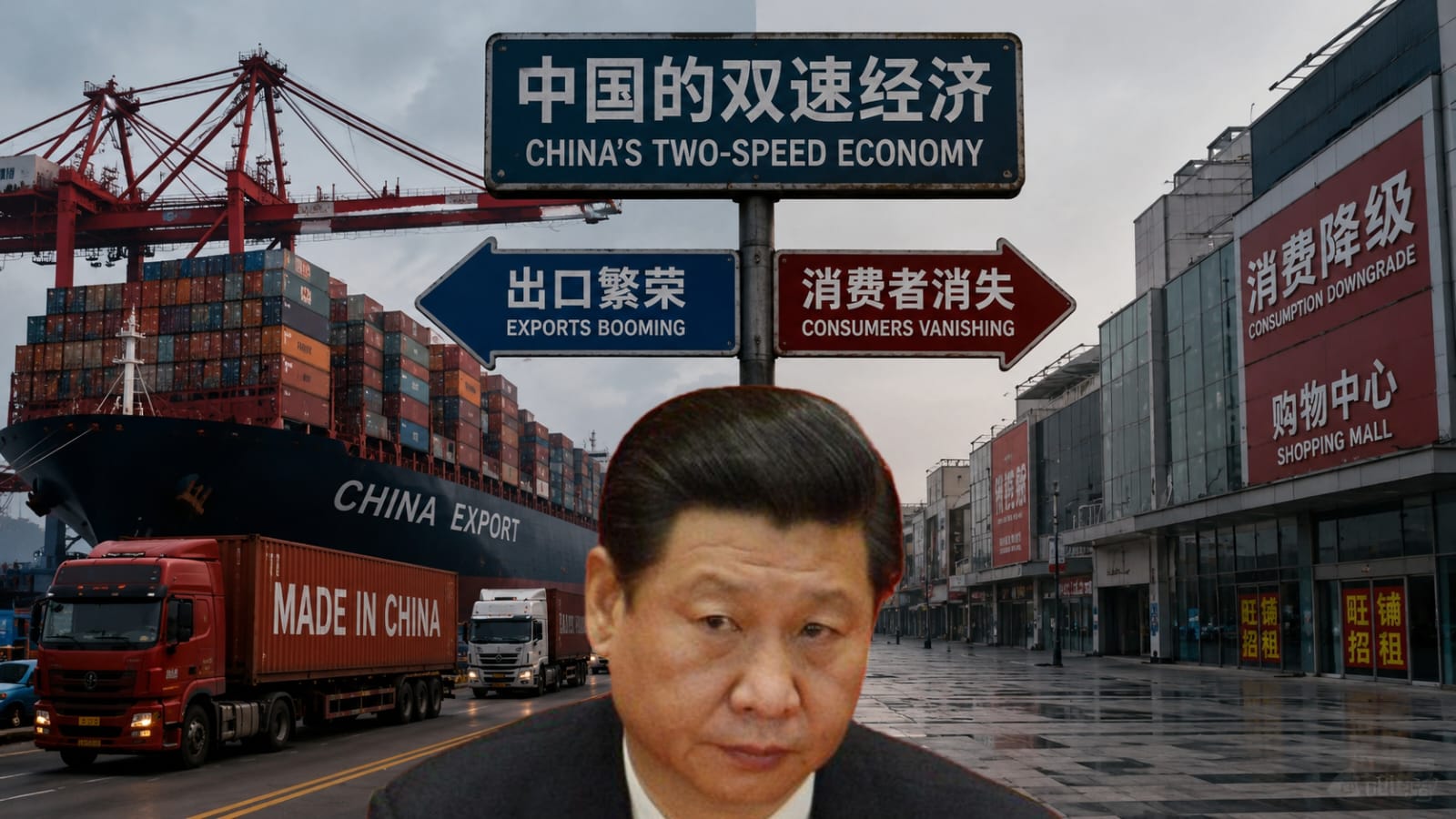
China’s Two-Speed Economy – Exports Booming, Consumers Vanishing
On one hand, exports are booming. Foreign money is pouring back into Chinese stocks. The government just injected eighty eight billion dollars into the banking system.
On the other hand, regular people are not spending money. Retail sales barely grew in April. Car sales crashed fifteen percent. People are paying off loans instead of taking new ones.
This is what economists are now calling China’s two-speed economy. The export and manufacturing side is strong. The domestic consumption side is weak. And the gap between them is getting wider.
Let me break down exactly what happened in April 2026, what the government is doing about it, and what this means for global markets.
Retail Sales Crash to 40 Month Low
The number that shocked everyone this month was retail sales.
China’s retail sales rose only 0.2 percent in April compared to last year. Expectations were for 2 percent growth. The actual number was ten times lower than what was expected.
This is the weakest reading since December 2022. That was when China was still coming out of COVID lockdowns.
People are not buying cars. Car sales fell fifteen percent in April. That is the steepest drop since mid 2022 when the country was under COVID restrictions.
People are not buying home appliances or furniture. Both categories declined at a double digit pace.
People are not buying jewelry. Gold, silver and jewelry sales plummeted twenty one percent.
Why is this happening? Consumer confidence is very low. Wages are not growing fast enough. The property market is still in trouble. And the recent Iran conflict has pushed up energy prices, which makes everything more expensive.
Industrial Output Slows to Three Year Low
It is not just consumers who are struggling.
Industrial production grew only 4.1 percent in April. That is the weakest pace in almost three years.
But here is the interesting part. The industrial sector is also becoming two speed.
Electronics production grew 15.6 percent in April. That is the fastest in two years. Why? Because global demand for artificial intelligence chips is exploding. China makes a lot of those components.
The automobile industry grew 9.2 percent, driven by overseas electric vehicle sales.
But commodities linked to real estate and construction like cement, glass and steel all recorded declines. The property market is still dragging down everything connected to it.
Investment Turns Negative Again
Fixed asset investment unexpectedly fell 1.6 percent in the first four months of 2026.
This matters because fixed asset investment includes spending on infrastructure, real estate, and factories. When this number turns negative, it means businesses are not confident enough to build new projects.
Private investment plunged especially hard. Manufacturing and infrastructure investment both weakened.
Some estimates suggest that investment dropped around 8 percent in April compared to last year. That is similar to the decline seen in the second half of 2025.
Exports Are the Only Bright Spot
So what is keeping the Chinese economy alive right now?
Exports.
Shipments climbed 15 percent in the first four months of 2026 compared to last year.
The global AI investment boom is a big reason. Chinese technology products are finding buyers all over the world. Demand for green energy products is also helping.
Trade ties with the United States are also stabilizing. A recent visit by the US President to Beijing has helped the outlook.
But here is the problem. Exports alone cannot carry the entire economy. China is a country of 1.4 billion people. Domestic consumption needs to work.
Foreign Investors Are Coming Back
Despite all the bad news, foreign investors are returning to Chinese stocks.
In April alone, overseas investors poured nearly twenty nine billion dollars into Chinese equities. That was the fifth largest foreign buying surge in the market’s history.
Total foreign investment into Chinese stocks so far in 2026 is about seventy two billion dollars.
Why are they coming back? Because Chinese stocks are cheap. The CSI 300 index climbed 8 percent in April and added another 1 percent in May. But it is still trading far below its past highs.
Major global financial firms have increased their exposure to Chinese stocks.
But here is the warning. Previous rallies in China often lost momentum after Beijing introduced new regulations. Investors are careful because they remember the 2021 crackdown on tech companies.
The other problem is that retail traders still dominate nearly 90 percent of daily trading in China. That means markets swing sharply on sentiment and policy signals instead of long term investment trends.
PBOC Injects 88 Billion Dollars
The People’s Bank of China is trying to help.
On May 25, 2026, the central bank will inject 600 billion yuan, which is about 88.2 billion dollars, into the market through its medium term lending facility.
This is a one year loan that Chinese banks can get from the central bank against their securities.
The market will receive a net injection of 100 billion yuan or about 14.7 billion dollars after institutions repay 500 billion yuan in maturing debt.
This is a significant liquidity boost. But will it be enough? Many economists are not sure.
Government’s Dilemma No Stimulus or More Stimulus
The Chinese government is in a difficult position.
On one hand, the economy clearly needs support. Retail sales are weak. Investment is negative. The property market is still falling.
On the other hand, the government has been reluctant to add more stimulus. Why? Because the Iran conflict has pushed up inflation. Consumer prices rose 1.2 percent in April. Producer prices jumped 2.8 percent, the highest since July 2022.
Higher inflation makes it harder to cut interest rates. The central bank last lowered the policy rate a year ago during trade tensions with the US.
Many economists believe the central bank will avoid lowering interest rates this year. However, some still expect a cut in the reserve requirement ratio, which is the amount of cash banks must hold in reserve.
The government pulled back on fiscal spending in March. But the April data is so weak that pressure is building for more action.
The next likely window for any policy adjustment is July. The Communist Party’s Politburo is scheduled to meet then to review economic growth and policy.
Property Market Still in Trouble
The property market remains the biggest problem.
Total investment in residential buildings fell 11.7 percent in March compared to last year. In cumulative terms for the first quarter, it declined 10.6 percent.
Recent forecasts suggest property sales will decline 10 to 14 percent in 2026. Previous estimates were only 5 to 8 percent.
The property market has seen annual sales volume cut in half over just four years. From 18.2 trillion yuan in 2021 to about 8.4 trillion yuan in 2025.
Prices are expected to fall another 2 to 4 percent this year following similar declines in 2025. Falling prices erode homebuyers confidence. It is a vicious cycle with no easy escape.
The floor space of new residential construction starts fell 22.3 percent in the first quarter. The floor space under construction fell 12 percent.
Developers are also not buying land. Land purchases by the top 100 real estate companies fell 49.4 percent in the first quarter.
There is one small sign of hope. In April, the year over year decline in sales of the top 100 real estate companies narrowed by 14.5 percentage points compared to March. Some major companies even recorded growth. But it is too early to call a recovery.
What to Watch Next
Here are the key things to watch in the coming weeks.
First, will the government announce more stimulus? The April data was very weak. Pressure is building. Watch for any announcements around the July Politburo meeting.
Second, will the central bank cut interest rates or the reserve requirement ratio? Inflation is rising, which makes rate cuts harder. But the economy needs support.
Third, will foreign investors keep buying Chinese stocks? They have put in seventy two billion dollars so far this year. But past rallies have failed when Beijing introduced new regulations.
Fourth, will the property market stabilize? Sales declines are slowing, but investment is still falling sharply.
Fifth, what will happen with US China trade relations? Recent diplomatic visits have helped stabilize things, but the situation remains fluid.
Final Thoughts
China is at a difficult crossroads.
The export side of the economy is doing well. Global demand for AI chips and green energy products is strong. Foreign investors are coming back.
But the domestic side is weak. People are not spending. Businesses are not investing. The property market is still falling.
The government has tools to fix this. can cut interest rates. They can increase fiscal spending. They can buy unsold property.
But so far, they have been cautious. The question is whether the April data will force them to act more aggressively.
For global investors, China remains a complicated story. The valuations are cheap. But the structural problems are real. The two speed economy is not going away anytime soon.
Stay informed. Watch the policy signals. And be careful with your exposure.
Disclaimer
This article is for general informational and educational purposes only. It does not constitute financial advice, investment advice, or trading recommendations. All investments involve risk. The author and website owner are not registered investment advisors. You should conduct your own research or consult a qualified financial advisor before making any investment decisions.
Also Read: Card 5. Capital One Venture Rewards Card – Best for Simple Travel Rewards